
TLDR
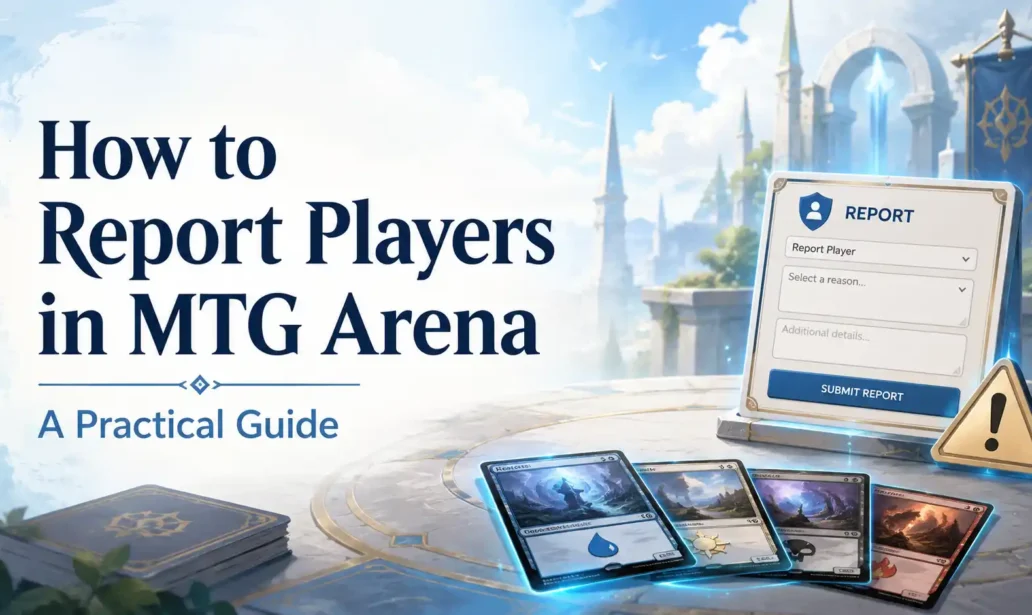
To report players in MTG Arena, use Wizards of the Coast’s MTG Arena support form, choose Report Conduct, describe the incident clearly, and attach useful evidence like screenshots, clips, or an HTML game log. Reportable conduct includes roping, harassment, inappropriate usernames, bug exploitation, hacking, doxxing, and other behavior that violates Wizards’ Code of Conduct. Do not report someone simply for playing slowly during a complicated turn, using a deck you dislike, winning with control, or using normal in-game emotes.
A Simple Way To Handle A Bad Arena Match
Most MTG Arena matches are normal Magic: someone curves out, someone floods, someone topdecks exactly the card they needed, and shuffle randomness can feel unfair, but that is part of Arena rather than something to report. When the issue is actual player behavior, the way to report a player in MTG Arena is to use Wizards of the Coast’s MTG Arena support form, choose Report Conduct, describe what happened clearly, and attach evidence such as screenshots, clips, or logs.
This guide is for MTG Arena players dealing with disruptive, abusive, or otherwise reportable conduct and wanting the correct way to file a report. The practical path is simple: gather the opponent’s name, match details, screenshots or clips, and logs when available, then submit a Report Conduct ticket through Wizards’ MTG Arena Helpdesk. Wizards’ own support article says to use the support request flow, select Report Conduct, describe the incident, and attach an HTML log file plus evidence when possible.
The available reporting channels are:
- the MTG Arena support form
- the in-client support route that helps capture logs
- Wizards’ broader reporting conduct page for official Wizards spaces
- community spaces for procedural advice, not public shaming
You will also see what behavior is worth reporting, how to collect useful evidence, what improves the odds of a clear review, what to expect after submission, and how community guidelines fit into keeping Arena fair, respectful, and easier to play for everyone.
For deck testing outside Arena, tabletop proxies from services like PrintMTG can be useful for casual Commander, Cube, and playtesting, but proxy use is a separate issue from Arena conduct reports. PrintMTG describes its proxies as intended for kitchen-table games, Cube, Commander nights, and proxy-friendly playtesting.
Understanding Report Conduct
“Report conduct” in MTG Arena means telling Wizards about behavior that may violate its rules for fair, respectful, and safe play. It is not a complaint button for every frustrating game, and normal variance is part of the reality.
Wizards’ Arena-specific Code of Conduct says MTG Arena players are expected to treat opponents with respect and fair play. It lists several reportable categories, including abuse, roping, harassment, obscenity, adult content, violent content, trolling, doxxing, bug exploitation, inappropriate usernames, and intentional hacking or modding of the game.
Reportable behavior can include:
- intentional roping or repeated stalling to waste time, including deliberate stall tactics that keep dragging a game out for extremely long stretches, even over 100 minutes in severe cases
- harassment through available social features
- offensive, hateful, or explicit usernames
- attempts to doxx another player
- exploiting a bug for advantage or abusing loopholes to gain an unfair edge
- hacking, modding, or manipulating the client
- repeated abusive behavior in direct challenges or social chat
- stream-sniping or coordinated behavior if you have evidence
Behavior that usually does not justify a report includes:
- a player taking time on a complicated board state
- a player disconnecting once
- a slow mobile or network connection
- normal emote use; if that feels annoying, you can mute emotes and focus on your own time
- a deck strategy you dislike
- control, combo, mill, discard, counterspells, sweepers, or other legal Magic gameplay
- losing a match in a frustrating way, or because shuffler outcomes did not break your way
The difference is intent and evidence. “My opponent took a long turn with six triggers on the stack” is probably just Magic being Magic. “My opponent had lethal on board, no decisions to make, and intentionally burned every timer across multiple turns” is closer to reportable stalling; note that serious findings can lead to suspension or a permanent ban, and repeat offenders may be banned.
Report Players In-Game Using The Drop Down Menu
The cleanest official route is not a universal right-click opponent menu. Wizards’ public support instructions point players to the MTG Arena support page, where the key dropdown is What would you like to contact us about? and the correct choice is Report Conduct.
A practical in-client workflow looks like this:
- Stay in the client if you can.
- Click the gear icon in the upper-right corner.
- Open the support or report option available from the client.
- Use the Report a Bug route if you need to capture a log from the current session.
- When the support page opens, use the dropdown menu and select Report Conduct.
- Fill in the description and attach evidence.
Wizards’ log-file instructions explain that, from inside the game, the gear icon can lead to a Report a Bug link and a Capture Log button. That route is a useful tool for reaching the proper form and capturing relevant session details, rather than a direct right-click report system. That route is useful because attaching a log can give support more information about the session.
The important dropdown option is Report Conduct. Wizards’ current public submit-a-request page also shows other options, such as account issues, technical troubleshooting, event problems, code redemption, order issues, and Arena Direct issues, but conduct reports belong under Report Conduct.
For the report reason, use the category that most closely matches the behavior. Wizards’ Arena Code of Conduct names the most relevant conduct types: roping or other abuse, harassment, trolling, doxxing, bug exploitation, inappropriate usernames, and hacking or modding.
Gathering Online Evidence
Good evidence is boring in the best way. It is specific, timestamped, and easy for support to understand.
Before you submit a report, write down:
- opponent username exactly as shown
- date and approximate time of the match
- your time zone
- format or queue, such as Ranked Standard, Draft, Brawl, or Direct Challenge
- event name if it happened inside an event
- game number if visible
- match tracker ID or replay-style link if you use a third-party tracker
- short description of what happened
Screenshots help most when they show the username, board state, timer, social message, or offensive name. If the issue involved chat through social features, direct challenge communication, or visible text, capture the relevant screen. If the issue involved emotes, screenshots may be less conclusive, so pair them with a timeline.
Clips can be stronger than screenshots for roping, repeated stalling, or bug exploitation. A 30-second clip showing the opponent repeatedly burning the timer with no meaningful decision may be more useful than a screenshot of one rope.
Game logs are also useful. Wizards specifically asks players to include an HTML log file when possible, along with stream clips or screenshots.
Export And Attach Game Logs When Available
On PC, Mac, or Steam, Wizards says players may be asked to enable Detailed Logs from the MTG Arena account settings, restart the client, recreate the issue, and send the log for that session. Wizards also notes that players can send logs proactively.
For HTML log files, the best-case situation is that you are still logged into the same game session. Use the gear icon, open the report/support route, and use Capture Log. If you already logged out, Wizards lists typical log-file locations for Windows, Steam, and Mac.
For iOS, Wizards says MTG Arena creates log files named in the format “UTC_Log – [Date] [Time].log,” and those logs can be exported through file sharing on Mac or through a file transfer program on Windows.
A simple attachment package could include:
- one screenshot showing the opponent’s name
- one screenshot or clip showing the behavior
- one HTML log file from the session
- a short timeline in the description field
Do not worry if you cannot provide every piece. A clear report with two useful screenshots is better than no report at all.
Report Players Via Helpdesk Ticket
To submit a Helpdesk report:
- Go to the MTG Arena support form.
- Choose Report Conduct from the dropdown menu.
- Add the opponent’s name.
- Describe the incident in plain language.
- Attach the relevant log file.
- Attach screenshots, stream clips, or other evidence.
- Submit the request.
You may wait a while before you hear back beyond the automated confirmation, so send the clearest evidence the first time.
Wizards’ official report-a-player article asks players to provide the opponent’s name and specific details in the description field, then attach an HTML log file and available evidence under attachments.
A good incident description looks like this:
“Opponent username: ExampleName#12345. Match was Ranked Historic on July 1 at approximately 8:35 p.m. Mountain time. After I presented lethal damage, the opponent repeatedly allowed the timer to burn down across three consecutive priority passes while taking no visible game actions. I attached screenshots showing the board state and a log from the session.”
That is calm, specific, and easy to review. It does not need insults. It does not need a paragraph about how much you hate the deck. Support needs facts, not fireballs.
When To Report Multiple Times
Do not submit five reports for the same single incident. That usually adds noise instead of clarity.
Submit another report when there is a new incident, a clear repeat pattern, or stronger new evidence. For example, if you face the same player three days later and they repeat the same conduct, submit a new report with the new match time, screenshots, and logs.
For repeat behavior, keep a simple private record:
- report date
- ticket or report ID
- opponent username
- format or event
- short summary
- evidence attached
If you already opened a ticket and simply need to add a missing screenshot or correction, reply to the existing ticket instead of creating a duplicate when possible. This keeps the report history cleaner and easier for support to follow.
Best Practices For Filing Reports
Use neutral, factual language. You are not trying to win an argument. You are trying to make the report easy to verify.
Good reporting language:
- “The opponent allowed the timer to expire repeatedly while taking no game actions.”
- “The username contained a slur.”
- “The attached clip shows the player exploiting the same bug three times.”
- “The attached screenshot shows the message I received after the match.”
Less helpful language:
- “This person is trash.”
- “Ban this idiot now.”
- “Everyone who plays this deck is toxic.”
- “They were definitely cheating because I lost.”
Support reviews facts about rules violations or bug exploiting, not claims that ordinary variance or one bad loss means the game is trying to break you.
Limit each report to one incident unless the incidents are clearly connected. If you include multiple examples, organize them by date and match so the reviewer does not have to untangle the story.
Also avoid exaggeration. “Repeatedly burned all available timers after lethal was presented” is stronger than “held me hostage forever” because it tells support what actually happened.
What To Expect After You Report Conduct
After submitting a report, expect an automated confirmation email first, but you may wait a while before you hear anything further. Wizards’ reporting conduct page says that, under its privacy policy, Wizards is unable to share information about actions taken against other individuals.
Possible outcomes can include no visible action, a request for more information, internal tracking if the behavior appears to be part of a broader pattern, or action against the reported account, including a suspension or a permanent ban if warranted. You should not expect Wizards to tell you which outcome occurred.
Do not escalate publicly unless you have new information and a good reason. Posting a username on Reddit, Discord, or social media rarely helps the formal review process, and it can create its own conduct problem if it turns into harassment or doxxing.
Community Options For Gathering Online Support
Community forums and Discord servers can be useful when you are trying to understand the reporting process. They are not a substitute for the official report. If Arena itself does not give you native match-history reporting, third-party trackers can help with evidence review or personal records. hey, if you want more examples from other players, you can also join community spaces for guidance.
Good community questions include:
- “Where do I find my Arena logs?”
- “Is this behavior considered roping?”
- “Which support category should I use?”
- “How do I capture a log on Mac?”
- “Does this look like a known bug or a conduct issue?”
Popular tracking tools include Untapped.gg, MTGA Assistant, and Arena Tutor. These tools read local game log files and generate complete match history, overall win rates, and deck-specific performance stats. Wizards of the Coast occasionally sends personalized seasonal gameplay reports via email, but those are not substitutes for incident reports.
Bad community posts include:
- “Everyone mass-report this player.”
- “Here is their personal information.”
- “Let’s harass this account.”
- “They beat me with control, so they must be cheating.”
Wizards’ Code of Conduct specifically warns against sharing personal information without consent, including identifying information, contact details, chat history, purchase history, and other account-related information.
If you share anything publicly, remove usernames unless they are necessary for procedural context, blur personal information, and focus on the process rather than punishment.
Quick Checklist Before You Submit
Before filing the report, make sure you have:
- the opponent’s exact username
- the queue, format, or event
- the approximate match time
- a short factual description
- screenshots or clips if available
- an HTML log if available
- one clear report category
- no profanity or personal attacks in the report
A good MTG Arena conduct report should read like a judge call, not a rage concede.
FAQs
Can You Report Roping In MTG Arena?
Yes. Wizards’ MTG Arena Code of Conduct specifically names “roping” as an example of reportable abuse, and intentionally dragging a game by burning timers or using loops to stall can be reportable; repeated abusing of that behavior can lead to account action. The stronger your evidence, the better. Try to document the board state, timer behavior, match time, and opponent name.
Can You Report An Offensive Username?
Yes. Wizards lists inappropriate usernames as reportable in MTG Arena. Include a screenshot showing the username exactly as it appeared.
Should You Report Someone For Playing Slowly?
Not always. Some annoying behavior is part of normal play, and if emotes are the issue, players can mute them rather than report the opponent. Report only when the behavior looks intentional, abusive, repeated, or clearly designed to waste time.
Do You Need A Game Log To Report A Player?
No, but it helps. Wizards asks players to include an HTML log file if possible, along with available evidence like stream clips or screenshots.
Will Wizards Tell You What Happened To The Player?
Usually not. Wizards says it cannot share information about actions taken against other individuals, though reports can result in suspension or a player being banned permanently.
Should You Post The Player’s Name Publicly?
Usually no. Use the official report process instead. If you ask a community for help, remove identifying details unless they are absolutely necessary, and never share personal information. You can also join community spaces for process help, but not for public callouts or harassment.