
TLDR
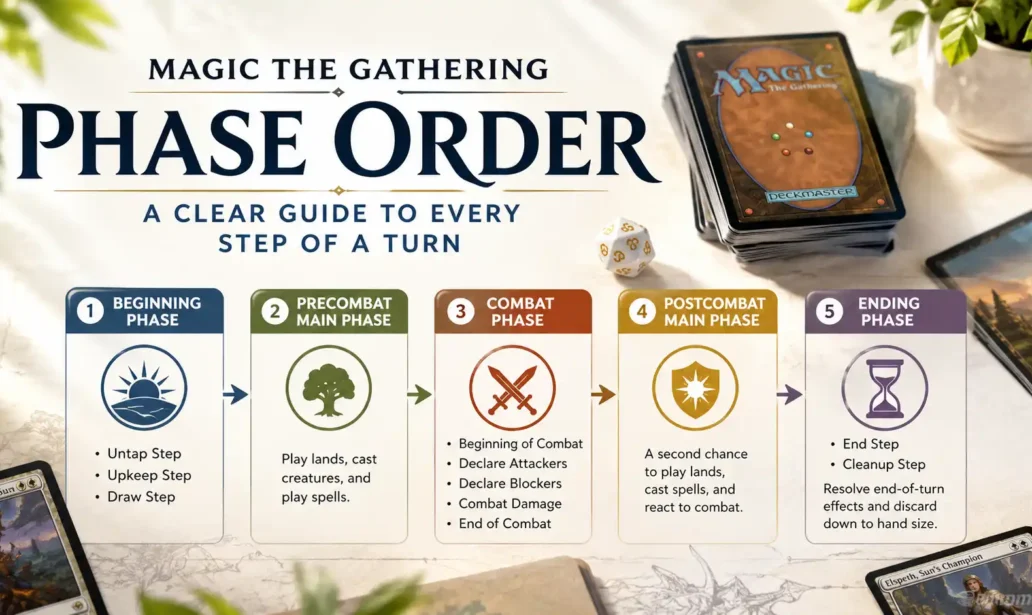
- The Magic the Gathering phase order is: beginning phase, precombat main phase, combat phase, postcombat main phase, and ending phase.
- The beginning phase has three steps: untap, upkeep, and draw.
- The combat phase has five steps: beginning of combat, declare attackers, declare blockers, combat damage, and end of combat.
- The ending phase has two steps: end step and cleanup step.
- Learning turn structure helps you time spells, triggers, attacks, and responses more cleanly.
A Magic turn can feel simple until someone says, “I’ll do that in your upkeep,” or “Before blocks, I have a response.” That is when the game stops being just lands, creatures, and attacks. The Magic the Gathering phase order starts to matter.
The short version is easy: every normal turn follows five phases in the same order. But the small timing details inside those phases decide a lot of games. They tell you when you can cast a sorcery, when attackers are chosen, when damage happens, when “at the beginning of your end step” triggers go on the stack, and why you usually cannot Lightning Bolt something during the untap step.
ProxyKing has a helpful overview of the topic in its guide to the five phases of Magic the Gathering. This article builds on that idea with a clear, practical breakdown for newer players, Commander tables, and anyone who wants fewer timing arguments.
The Magic the Gathering Phase Order
The standard Magic the Gathering phase order is:
- Beginning Phase
- Precombat Main Phase
- Combat Phase
- Postcombat Main Phase
- Ending Phase
Those phases happen every turn, even if nothing important happens in one of them. That matters. A player still has a beginning phase even if they have no upkeep triggers. A player still moves through combat even if they attack with nothing. A player still has an ending phase even if no one says “end step.”
The rules also divide some phases into steps. The beginning, combat, and ending phases have steps. The main phases do not.
That is the clean framework. Now we can look at what each part actually does.
Beginning Phase: Untap, Upkeep, Draw
The beginning phase has three steps:
- Untap step
- Upkeep step
- Draw step
Most turns start with a familiar rhythm: untap, upkeep, draw. Players say it quickly because the early turn often has no decisions. But each step matters.
During the untap step, the active player untaps their permanents. In normal play, this means turning tapped lands, creatures, artifacts, and other tapped cards upright again. Players do not normally get priority during the untap step, so this is not the time to cast instants or activate most abilities.
The upkeep step is where many recurring triggers happen. Cards that say “at the beginning of your upkeep” trigger here. This is also the first common place where players may act during a turn. For example, an opponent may cast an instant during your upkeep before you draw for the turn.
The draw step is where the active player draws a card. After that draw happens, players may receive priority. This is why timing can get tricky. An opponent may wait until your draw step to act because you have drawn a card but have not reached your main phase yet.
In casual games, most players move through the beginning phase quickly. That is fine. Just slow down when there are upkeep triggers, cards that care about drawing, or opponents holding up instant-speed interaction.
Precombat Main Phase: Your First Window to Build
The precombat main phase is the first main phase of the turn. This is your first normal chance to play a land, cast creatures, cast sorceries, cast artifacts, cast enchantments, and cast planeswalkers.
A few important things happen here:
- You can play one land for the turn, assuming you have not already played one.
- You can cast sorcery-speed spells when the stack is empty.
- You can cast instants and activate abilities when you have priority.
- Saga lore counters and some other turn-based actions can happen in this part of the turn.
Newer players often cast everything before combat because it feels natural. You untap, draw, then play your cards. That works often enough, but it is not always best.
A good habit is to ask: does this spell affect combat?
If the answer is yes, cast it before combat. A haste creature, an anthem effect, an Equipment, or a removal spell that clears a blocker may need to happen now.
If the answer is no, consider waiting until your postcombat main phase. Holding the spell back gives your opponents less information when they decide how to block or whether to use removal. It also protects you from wasting mana before seeing how combat goes.
This one timing habit improves a lot of games.
Combat Phase: The Most Misplayed Part of the Turn
The combat phase has five steps:
- Beginning of combat
- Declare attackers
- Declare blockers
- Combat damage
- End of combat
Combat feels like “attack and block,” but the steps are more precise than that.
During the beginning of combat step, players can act before attackers are declared. This is the time for effects that tap a creature before it attacks. Once the game moves to declare attackers, it is too late to stop a creature from attacking by tapping it. The creature is already attacking at that point.
During the declare attackers step, the active player chooses which creatures attack and who or what they attack. In multiplayer formats like Commander, that may mean attacking different opponents, planeswalkers, or battles. After attackers are declared, attack triggers go on the stack.
During the declare blockers step, defending players choose blocks. After blockers are declared, block triggers go on the stack. This is also a common place for combat tricks. A player may cast a pump spell after blockers are chosen but before combat damage happens.
During the combat damage step, attacking and blocking creatures deal combat damage. If creatures with first strike or double strike are involved, combat can include an additional combat damage step.
The end of combat step is the final step of the combat phase. Some cards trigger here, and “until end of combat” effects wear off at the end of the combat phase.
The big lesson: do not rush combat. Ask for the step that matters.
Say things like:
- “Before attackers, I’ll tap that creature.”
- “After attackers, before blocks, I have a spell.”
- “After blocks, before damage, I’ll cast this.”
- “At end of combat, this trigger happens.”
That language keeps the table clear.
Postcombat Main Phase: Your Second Chance to Cast Spells
After combat, the active player gets a postcombat main phase. This is often called the second main phase.
It works much like the first main phase. You can cast sorcery-speed spells, play a land if you have not played one already, and use abilities when you have priority.
The second main phase is often the better place to cast cards that do not affect combat.
For example, say you have a creature with no haste. If you cast it before combat, your opponent sees it before choosing blocks. That may change their decisions. If you cast it after combat, you gave away less information and still end the turn with the creature on board.
This does not mean you should always wait. Sometimes you need to spend mana before combat. Sometimes you want to bait interaction. Sometimes your deck has main-phase triggers that change the math.
But as a general rule, if a spell does not help your attack, your blocks, or your combat damage, think about saving it for the postcombat main phase.
Ending Phase: End Step and Cleanup
The ending phase has two steps:
- End step
- Cleanup step
The end step is where “at the beginning of your end step” triggers happen. This is also the last normal point in the turn where players get priority. Many players use this window to cast instants if they did not need to use them earlier.
For example, an opponent might say, “On your end step, I’ll draw two cards.” That is common because they get to keep mana open during your turn, then use it right before their own turn begins.
The cleanup step is different. This is where the active player discards down to maximum hand size, normally seven cards. Damage marked on creatures is removed, and “until end of turn” effects end.
Players normally do not get priority during cleanup. There are exceptions, usually when a state-based action or triggered ability needs to happen during cleanup. If that happens, players can act, and then the game creates another cleanup step afterward.
Most casual games do not need to think about that exception often. But it explains why cleanup is not exactly the same as “nothing can ever happen here.” Magic has a habit of making the simple parts slightly less simple.
How Priority Fits Into MTG Turn Structure
Priority is the permission to act. A player with priority can cast an instant, activate an ability, or take certain special actions.
For a phase or step to end, the stack must be empty and all players must pass priority in succession. That sentence sounds technical, but the table version is simple: everyone has to be done before the game moves on.
This matters because a player cannot force the game forward while another player still has a legal response. It also means that after a spell resolves, players may get another chance to act before the phase or step ends.
Here is a common Commander example:
You cast a creature in your precombat main phase. It resolves. You say, “Move to combat?” Each opponent now has a chance to act before the game reaches combat. If everyone passes, the game moves forward.
This is why clear shortcuts help. Saying “combat?” or “end step?” gives players a chance to stop at the right point.
Common Phase Order Mistakes
A lot of timing mistakes come from players using loose language. That is normal, especially at casual tables. But knowing the phase order helps prevent messy take-backs.
Here are a few common mistakes:
- Trying to tap a creature after attackers are declared to stop it from attacking.
- Casting a sorcery during combat without a card that allows it.
- Playing a land during the opponent’s turn.
- Forgetting upkeep triggers until after drawing.
- Thinking the second main phase gives you a second land drop.
- Waiting until cleanup to cast a normal instant.
- Moving through combat too quickly without giving opponents a chance to respond.
The fix is not to turn every casual game into a judge call. The fix is to use clear timing.
Try saying:
“I’m moving to combat. Any effects before attackers?”
That one sentence prevents a lot of confusion.
Why Phase Order Matters for Playtesting and Proxies
Understanding turn structure is especially useful when you are testing decks. A card may look strong on paper, but the real question is where it fits into your turn.
Does it need to be cast before combat? Does it work better after attacks? Does it trigger on upkeep? Does it require holding mana open until an opponent’s end step?
That is one reason proxies are helpful in casual playtesting. ProxyKing makes MTG proxy and playtest cards for Commander, cubes, and casual groups where proxies are allowed. Testing with proxies can help you learn not just whether a card is powerful, but when the card actually matters inside a turn.
This is important with expensive staples, combo pieces, and cards with narrow timing windows. A card that looks great may feel clunky if your deck never has the right phase or priority window to use it well.
As always, proxies are for casual play and playtesting where allowed. They are not for Wizards-sanctioned events, and they should never be represented as authentic Magic cards.
Quick Turn Structure Cheat Sheet
Here is the clean version to keep near the table:
Beginning Phase:
Untap, upkeep, draw.
Precombat Main Phase:
Play lands, cast creatures, artifacts, enchantments, planeswalkers, and sorceries. Cast instants when you have priority.
Combat Phase:
Beginning of combat, declare attackers, declare blockers, combat damage, end of combat.
Postcombat Main Phase:
Another main phase. Cast sorcery-speed spells and play your land if you have not played one yet.
Ending Phase:
End step, then cleanup. End step is the last normal response window. Cleanup handles discarding, damage removal, and “until end of turn” effects.
FAQs
What is the correct Magic the Gathering phase order?
The correct Magic the Gathering phase order is beginning phase, precombat main phase, combat phase, postcombat main phase, and ending phase.
What are the steps in the beginning phase?
The beginning phase has three steps: untap, upkeep, and draw. Players usually do not get priority during the untap step, but they can normally act during upkeep and after the draw step begins.
Can I cast creatures during combat?
Normally, no. Creatures are usually cast during one of your main phases when the stack is empty. You need flash or another special effect to cast a creature during combat.
Can I play a land in both main phases?
Not normally. You usually get one land play per turn. If you already played a land in your precombat main phase, you cannot play another in your postcombat main phase unless an effect gives you an additional land play.
When should I cast instants?
You can cast instants whenever you have priority. Common timing windows include upkeep, draw step after the draw, before attackers, after attackers, after blockers, end of combat, and the end step.
What happens during cleanup?
During cleanup, the active player discards down to maximum hand size, damage marked on permanents is removed, and “until end of turn” or “this turn” effects end. Players normally do not get priority during cleanup unless a special rule exception applies.