TLDR
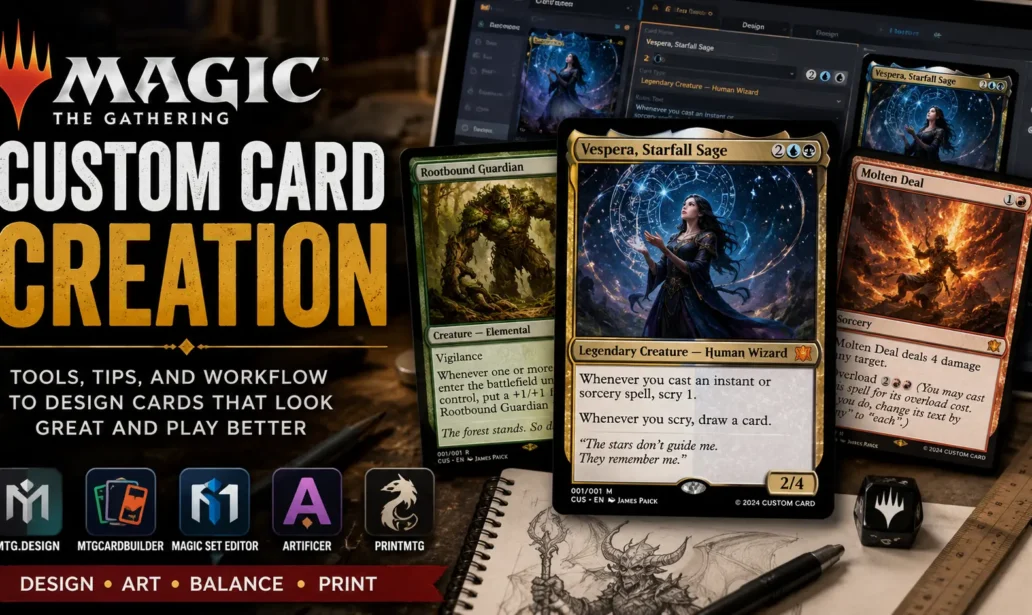
- Magic: The Gathering custom card creation works best when you separate the project into five steps: concept, rules text, art, layout and printing.
- Use MTG.Design or MTGCardBuilder for quick single cards, Magic Set Editor for full sets, Artificer for mobile card design and Card Conjurer for deeper frame customization.
- For physical cards, PrintMTG is a strong fit because its MTG Card Maker lets you design, preview and order custom MTG-style cards in one workflow.
- The best custom cards are readable, simple enough to explain themselves and close enough to Magic’s color pie that players understand them at a glance.
A good custom Magic card passes a very simple test: someone across the table can read it, understand it and want to play with it. That sounds obvious, but it is where a lot of homemade cards fall apart. The art may be cool. The joke may land. The frame may look right. But if the rules text takes three reads, the card is going to spend more time being explained than played.
Magic: The Gathering custom card creation can be as simple as making a funny birthday card for a friend or as involved as building a full custom Cube with new mechanics, custom tokens, set symbols and draft themes. The trick is choosing the right tool for the job, then designing the card like a player instead of just decorating a frame.
What Magic: The Gathering Custom Card Creation Includes
Custom MTG cards usually fall into a few buckets.
Some are personal cards: a friend as a legendary creature, a pet as a token, a wedding party as a Commander pod or a private joke turned into cardboard. These cards do not need to be perfectly balanced. They just need to be readable, fun and clear enough that the table gets the joke.
Other custom cards are design projects. These might include a custom Commander, a cycle of lands, new mechanics for a Cube or a whole fan-made set. This is where balance matters more. A card that is cute once can become miserable if it shows up every game and draws six cards for two mana.
Then there are custom proxies and alternate-art cards. These often use existing Magic card text but change the art, frame treatment or presentation. The goal should be clean, readable cards that are easy to recognize in sleeves. You are not trying to confuse the table. You are trying to make something that looks good and plays smoothly.
That distinction matters. Custom card creation is not only about making something “look like Magic.” It is about making something that behaves like Magic at the table.
Choose The Right MTG Card Maker
There is no single best tool for every project. The right MTG card maker depends on whether you are making one card, building a full set, designing on your phone or trying to get physical cards printed.
| Tool | Best For | What To Watch |
|---|---|---|
| MTG.Design | Fast browser-based custom cards | Great for quick cards, less ideal for massive set management |
| MTGCardBuilder | High-resolution custom cards and community examples | Lots of options can be distracting if you are new |
| Magic Set Editor | Full custom sets, batches and organized card files | More of a learning curve than a simple web editor |
| Card Conjurer | Frame control and detailed custom layouts | Better for users who like tweaking small visual details |
| Artificer | Mobile card design on iOS or Android | Best for quick ideas and phone-first workflows |
| PrintMTG | Designing, previewing and printing custom cards | Best when you want physical cards, not just image files |
| MakePlayingCards | Uploading finished card images for printing | You need to prepare files correctly before upload |
For most people, the easiest path is this: use a simple tool for your first card, then upgrade your workflow only when your project needs it.
If you are making one custom Commander, start with MTG.Design, MTGCardBuilder or PrintMTG’s card maker. If you are building a full set with commons, uncommons, rares, mythics, tokens, mechanics and color balance, Magic Set Editor makes more sense because organization matters. If the idea hits while you are away from your computer, Artificer is useful as a mobile sketchbook for card ideas.
PrintMTG is especially useful when the end goal is physical cards. Instead of designing in one place, exporting files, checking sizes, then uploading somewhere else, you can build the card in the MTG Card Maker, preview it and move toward printing from the same site.
Start With The Card Idea, Not The Frame
It is tempting to open a card maker, pick a frame and start typing. That works for a meme card. It is not the best way to make a card that plays well.
Start with one sentence:
“This is a green creature that rewards me for playing large creatures.”
That is better than starting with:
“Legendary creature, five mana, trample, draw cards, make tokens, gain life, maybe fight something.”
The first version has direction. The second version is a pile of cool things. Magic has a lot of cool things. You do not need to use all of them on the same card.
A useful custom card concept should answer four questions:
- What is the card’s role?
- What color or colors should it be?
- What kind of player is supposed to enjoy it?
- What board state does it create?
For example, a red instant that deals damage and creates a Treasure has a clear job. A blue enchantment that copies spells only during your turn has a clear audience. A black legendary creature that sacrifices creatures for cards and life loss tells you how the deck wants to play.
The clearer the role, the easier the rest gets.
Respect The Color Pie Enough To Feel Like Magic
The color pie is one of the main reasons Magic cards feel coherent. White gets order, armies, protection and small creature coordination. Blue gets card draw, counterspells, bounce and tricky timing. Black gets sacrifice, removal, recursion and life as a resource. Red gets damage, impulse, speed and chaos. Green gets mana, big creatures, growth and natural force.
You can bend expectations. Magic does that all the time. But if every custom card ignores the color pie, the set starts to feel like a kitchen sink.
A good rule: break one expectation at a time.
A green card that draws cards when big creatures enter the battlefield feels natural. A green card that counters any spell for two mana feels off. A red creature that impulsively exiles cards to play this turn feels modern and readable. A red creature that repeatedly destroys enchantments with no condition feels less red.
This does not mean your design has to be boring. It means the card should give players a familiar place to stand before you show them the twist.
Write Rules Text Players Can Understand
Rules text is where custom cards usually get into trouble. Designers want the card to do everything in their head. The text box disagrees.
Wizards of the Coast designer Mark Rosewater has repeated a useful design idea over the years: good design leans toward simplicity. If the card cannot explain itself through the rules text, the design has a problem.
That is even more important for custom cards because your players do not have years of format context for your new mechanic. They only have the card in front of them.
Here is a rough custom card wording checklist:
- Use existing Magic wording when possible.
- Keep the main effect easy to understand.
- Avoid adding tiny bonus abilities that barely matter.
- Read the card out loud before calling it done.
- Ask someone else what the card does without explaining it first.
A messy version might look like this:
“Whenever a creature dies, this gets stronger and maybe you draw if it was yours but only if you paid life this turn.”
A cleaner version:
“Whenever another creature you control dies, put a +1/+1 counter on CARDNAME. This ability triggers only once each turn.”
The second version may be less flashy, but it plays better. It has a trigger, a result and a built-in limit. Players can process that.
For custom cards, clarity is a form of power. A readable card gets played more because players trust it faster.
Pick Art That Fits The Card
Great art does not automatically make a great custom Magic card, but bad art placement can hurt a good design. MTG card art has to work in a small rectangle, often with text, type lines, power/toughness boxes and frame elements around it.
ArtStation and DeviantArt are useful places to find fantasy art inspiration, especially if you want a professional look. Just be careful about usage. If you plan to publish, sell or broadly share a custom design, get permission or use art that allows your intended use.
AI art tools like Midjourney, DALL-E and WOMBO can also help with custom card concepts. They are useful when you need something specific, like “a ghostly elk made of starlight in an ancient forest” or “a goblin accountant guarding a treasure ledger.” That said, AI art often needs cleanup. Check hands, weapons, faces, text, borders and strange background details before you build the card.
For custom MTG art, the best image is not always the most detailed one. The best image is the one that still reads when it is card-sized.
Look for:
- A clear subject
- Strong contrast
- Space around the focal point
- No important details hidden under the title or type line
- A mood that matches the card’s color and mechanics
A black removal spell should probably not look like a sunny picnic. Unless that is the joke. And if it is the joke, commit to it.
Prepare Custom Cards For Printing
Digital cards are forgiving. Printed cards are not.
Before you print custom MTG cards, check the basics: resolution, crop, safe zone, text size and contrast. A card that looks sharp on a large monitor can look crowded once it is printed at actual card size.
Print a single test card before printing a whole custom set if the project is large. This catches problems that are easy to miss on screen: tiny rules text, art that is too dark, mana symbols that blend into the frame or flavor text that looked charming until it became a gray smudge.
PrintMTG is a good option when you want a simpler design-to-print path. Its MTG Card Maker lets you choose a frame, edit card details, upload artwork, adjust placement, preview the card and order prints. That is helpful because custom card projects often fall apart during the export-and-upload stage.
MakePlayingCards can also work when you already have finished card images prepared correctly. It is more of a file-upload route, while PrintMTG is more directly centered on MTG-style custom cards and proxy printing.
Either way, the goal is not to chase a counterfeit look. The goal is a clean custom card that shuffles well, reads well and makes sense in sleeves.
A Simple Workflow For Better Custom MTG Cards
Here is a practical workflow that works for most custom projects:
- Write the card idea in one sentence.
- Choose the color identity and card type.
- Draft the rules text without worrying about the frame yet.
- Compare the card to three real Magic cards with similar effects.
- Adjust mana cost, stats and limits.
- Choose art that reads clearly at card size.
- Build the card in MTG.Design, MTGCardBuilder, Magic Set Editor, Artificer, Card Conjurer or PrintMTG.
- Check readability at actual card size.
- Print one test if the project matters.
- Revise before printing the full batch.
The comparison step is the one most people skip. Do not skip it.
If your custom two-mana creature draws two cards every turn, compare it to real two-mana creatures that generate value. If your custom board wipe costs three mana, compare it to real sweepers. If your custom Commander makes tokens, draws cards and ramps, ask which part is supposed to be the actual payoff.
Custom cards do not need to be perfectly balanced. But they should be balanced enough that your friends want to play against them twice.
Common Mistakes To Avoid
The most common custom card mistake is doing too much. One card does not need three triggered abilities, two replacement effects and a paragraph of flavor text. Pick the part that matters.
The second mistake is using art that does not fit the layout. If the subject’s face is covered by the title bar or the action happens at the very bottom of the frame, the card will feel off even if the art itself is strong.
The third mistake is ignoring the type line. “Legendary Creature — Human Wizard” tells players a lot. So does “Artifact Creature — Golem” or “Enchantment — Aura.” Make sure the type line supports the card’s mechanics.
The fourth mistake is forgetting that Magic is played across a table. Your card should pass the arm’s-length test. If a player has to pick it up every time it triggers, the design may be too dense.
And the fifth mistake is printing too soon. Custom cards almost always improve after one more editing pass.
FAQs
What Is The Best Tool For Magic: The Gathering Custom Card Creation?
For quick single cards, MTG.Design and MTGCardBuilder are easy places to start. For full custom sets, Magic Set Editor is usually better because it helps organize many cards. For mobile design, Artificer is convenient. For physical custom cards, PrintMTG is a strong option because it connects card design and printing in one workflow.
Can I Use AI Art For Custom MTG Cards?
Yes, AI art tools can help create original fantasy concepts, especially for personal cards and casual projects. Review the image carefully before printing. AI tools can produce odd hands, unclear faces, strange weapons or random marks that look fine at first glance but stand out on a printed card.
How Do I Make A Custom Magic Card Balanced?
Compare your custom card to real Magic cards with similar effects. Look at mana cost, color, card type, timing, stats and restrictions. If your card is cheaper, stronger and more flexible than every similar card, it probably needs a drawback or higher cost.
Should I Make A Single Custom Card Or A Full Custom Set?
Make a single card if the goal is a gift, joke, custom Commander or alternate-art idea. Build a full set only if you want a larger design project with themes, mechanics, rarity balance and repeatable gameplay. Full sets are fun, but they take real organization.
Can I Print Custom MTG Cards From My Own Designs?
Yes. You can export designs from a card maker or use a printing-focused tool like PrintMTG’s MTG Card Maker. Before printing, check the crop, safe zone, text size and image resolution. A quick proof can save you from printing a full batch with a typo in the rules text.